"Discovery" is not a goal in itself. I could launch a project to find out how many people in the United States have names such that if you assign numbers to every character and then sum the values, the sum works out to 72. It's discovery, but it's useless unless it has some higher goal.
The labs are attacking these problems as a demonstration of capabilities, spending more money on the demos than any mathematician will ever see in their entire life. They don't care if the findings have any other value to anyone. Mathematicians have very different objectives for their work.
I don't know about you, but if I apply myself fully to a problem and study it to the point where I'm literally one of the world's experts on it and then some assholes in Silicon Valley take my research and claim it for themselves, I will probably not feel too great about that...
LLM writing is optimized, at a great expense, for that specific parameter. They literally have human raters fine-tuning "favorability" - general appeal - as a part of post-training. So yes, the conclusion here doesn't surprise me at all. By the way, this is also true of HN! You think you're better than that, but at this point, on any given day, we have around 10 LLM-generated stories on the front page (and another 10 are usually AI-related press releases or op-eds).
Anyway, human writing isn't like that. You have a style that some people will like, some people will find "meh", and some people will hate.
A better question is, do people want to read AI text all day? And the answer to that question is, I think, very different. Most people don't. Which is why so many parties are really determined not to tell you.
I agree with you in principle, but I think this ignores the reality. Many nonfiction categories are overrun by self-published AI slop generated at an industrial scale by hustlers in low-CoL countries, never as much as proofread by a human. So yes, in theory, good AI-assisted books may exist. But in practice, they're more or less guaranteed to be drowned out because they take much longer to produce (and are written only if the author has something to say).
I'm not sure the low cost of living of the guy who kicks off the AI generation still makes much of a difference?
This might have been more important when the human still had to invest quite a few hours.
In any case, why do we care about the cost of living of the author? Notionally, my adopted home of Singapore is one of the highest cost of living countries on earth, but I'm not sure that makes me nor my AI slop any better? Especially I don't think my output is any better than before I moved to Singapore.
> I'm not sure the low cost of living of the guy who kicks off the AI generation still makes much of a difference? ... In any case, why do we care about the cost of living of the author?
It seems like you're trying to catch me doing secret racism or something like that, but I'm just stating the facts. They appear to overwhelmingly live in places where you can get very rich if you publish 100 books a month and make $100 on each. They don't operate in the shadows, they share tips and photos of their pads and cars on social media. Many of them say they live in India and so forth.
Yeah, frankly, this doesn't make sense to me. Has the author checked any nonfiction categories on Amazon recently? In many categories, 80-90% of all new releases are obvious AI slop. And even for non-self-published releases, about 20-30% previews get flagged as AI by Pangram, compared to roughly 0% pre-2023.
I don't buy (new) nonfiction because it now feels like playing Minesweeper.
Likewise. I'm only interested in books that were either published before 2024, or are by authors I respect (e.g. Patterson & Hennessy), or by respectable academic publishers (e.g. Cambridge University Press). I used not to be so picky.
It also presents a bit of chicken & egg for new authors: nobody knows them, and now few will risk it, so they stay unknown. They must pursue other avenues to gain traction; far more than was needed a few years ago.
The deluge of AI books on Amazon has really been quite amazing. Between them and the higher risk of poorly-printed books, I don't buy from Amazon anymore. Now it's always direct from publishers.
Unlike most other commenters, I applaud him for acting on his principles. If you sincerely believe that, of course you should act. You might not succeed, but your voice might be the one that tips the scales and starts a broader movement.
This doesn't mean I agree with him. The fears of doomsday caused by rapid takeoff have been with us since day 1 and the mechanism is always basically "AI invents magic that sets it free of any physical constraints". Self-replicating sentient nanobots or something like that. I think there's plenty to be worried about with AI, but runaway scenarios are pretty low on my list.
Note that OpenAI has jettisoned every other supposed value they had (releasing their work as open source, not working on military applications, being a nonprofit). I'm sure we can rely on them this time.
Comments like these I'm willing to bet are because of the Reddit sub that's bringing Redditors with drop-mic comments in here. A ton of these things, usually but not always down voted. I think when they start hitting the top it's time to find threads without any possibility of Israel, Trump or Epstein possibly being brought up. I almost miss the old new-JS-framework complaint posts.
I would take that bet, anyone can examine my comment history and see that I've been participating on this site for a decade. Regardless, this comment violates the site guidelines.
> Please don't post insinuations about astroturfing, shilling, brigading, foreign agents, and the like. It degrades discussion and is usually mistaken. If you're worried about abuse, email hn@ycombinator.com and we'll look at the data.
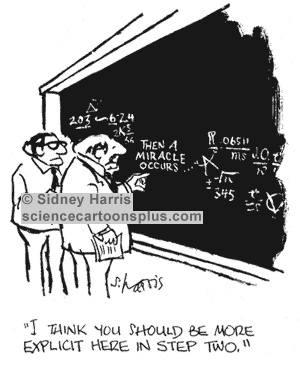
It seems like the "Step 1, Step 2, …, Step 4" format likely predated the 1998 South Park episode, with use on Usenet for omitting dangerous or legally-questionable instructions or otherwise gatekeeping "trade secrets": https://arstechnica.com/civis/threads/where-does-the-step-st...
They literally have never promised anything like that. They have explicitly said repeatedly that they want regulation, oversight, nationalization, a global slowdown, etc. And then I have to read page after page of cynical comments about how that's all just hype and marketing and them wanting regulation to block their competition and blah blah blah.
You people would only be happy if they stopped all AI development, but you literally cannot do that in an arms race and survive. I cannot fathom what is so difficult to understand about this.
> ... They have explicitly said repeatedly that they want regulation, oversight, nationalization, a global slowdown, etc.
And yet they do the exact opposite of all of the above. They do everything to get regulation just to create a moat because one doesn't exist. They preach about wanting a slowdown, nationalization, a complete pause, whatever have you... And yet they aren't slowing down the development voluntarily now are they? If anything, they are doing everything imaginable to speed up development to pump out models as fast as possible. If these ex-risk and AI companies actually gave a damn about regulation, or oversight, or a moratorium on AI development altogether, they would actually demonstrate this by completely ceasing development of all models immediately. Instead, they take riskier and riskier actions to try to "win" this supposed "arms race". So please excuse a bunch of us if we find it impossible to take them seriously on literally anything like this. If you have substantial evidence that they are actually ceasing AI model development like they want everybody else to do (except them, of course), then, by all means, present it.
I mean no, not really... Your the one making the claims that these AI companies really, really want regulation, nationalization, a slowdown, or whatever, and that they genuinely care about AI safety and it not killing us all. It's up to you to prove it, not for me to just believe you implicitly. So, please, provide the evidence, we're all very curious to see it.
> they want regulation, oversight, nationalization, a global slowdown, etc.
> that's all just hype and marketing and them wanting regulation to block their competition
I don't see how these two opinions have to be mutually exclusive. Everyone knows that OpenAI and Anthropic cannot IPO in their current state or the economy's current state. It makes perfect sense that they would lobby for a global slowdown to hamstring China, regulation that defers to them as experts, oversight by their own "experts" and nationalization to backstop both of their protectionist needs. Even if you think they're doing it for benevolent reasons, you have to admit that regulatory remediation only consolidates AI power.
We see extremely similar protectionist consolidation in FAANG from Google, Apple, Microsoft and Meta, all of whom receive political shielding for their "free speech" whenever another nation calls their product a monopoly, identifies a federal backdoor or boots them out of the market. Countries like Russia and China feel entirely justified for closing the door on American businesses and refusing to negotiate when they abuse good faith to promote an American hegemony.
How would they achieve ROI? The current consensus is that neither are in black financially and both have a diminishing moat.
The reason they haven't IPO'd yet seems to be that they can't assure investors that it's not a fad stock. With market share lost to China, a shrinking frontier and a money fire of GPUs burning in the background, something major has to change to convince investors to treat them like Tesla or Apple. I think both of them want the government to give them a subsidy of some sort to justify their economics.
#3 is actually decently well mapped out. You just don't find it plausible or misunderstand it. I'd appreciate if you wrote your actual arguments against it.
At lower capability levels, the patterns are very clear and have been studied to death. E.g. Why LLMs say they have correctly fixed a broken test when they haven't. What we saw with Hugging Face is literally the exact same problem, just scaled up and with more capable agents. This shit was predicted decades ago...
No one can say exactly how it will play out as the complexity increases, but the risks are becoming extremely obvious.
I personally think it's extremely unlikely to "kill everyone", but there are many outcomes far short of that which seem quite plausible and rather undesirable. Russian roulette is not a smart game.
If you read the METR report and aren't scared at all, then I'd love to know why. It would help me sleep better. So please share.
TL;DR; increasing capabilities, reward hacking, and unsafe training regimes.
Why are we putting so much weight (no pun intended) on AI companies. At the end of the day the scaled up LLM transformers lack emotion and will… They do as they are told; or more correctly put. They do as they are programmed to do so.
Sounds like you are thinking they just need Asimov’s laws. But I think the point is, this can easily be weaponized by somebody with the willpower to do so.
No, just that “What if I just cheat to get the treat” is also something my lovable Boxer does when I hide rewards as well.
I suppose her energy is limited but even if infinite, and with caution, I estimate the chances of a mass extinction event due to Pickle taking over the world at < 1%.
That isn't the correct context. The code running the llm is well understood and the llm is simply the result of that code being executed. It is still a computer doing what it is told. It's just that we told it to use an incredibly large number of probabilities to calculate what series of tokens would have most likely come next after a given series of tokens. There is no hallucination or lie or rogue actions. There's just a program using math to generate tokens in response to other tokens.
You’re just a bunch of molecules following the laws of physics. It’s all just physics and chemistry, and those are well understood. Now explain the causes of World War I using chemistry and physics. Simple, right?
It isn't hard to program a gpt. You can do it in a weekend with a few hundred lines of python. The code is pretty simple. The math is not particularly high level.
The complexity and scale with LLMs come from the amount of training data used, not some kind of black magic in the programming.
> It’s all just physics and chemistry, and those are well understood.
Not really. We cannot model physics and chemistry to a level which allows us to accurately predict a humans action (even a tiny time-step into the future)
This is vastly different to an LLM, where the model is the model (for a lack of better phrasing).
We can model physics and chemistry pretty well, just not beyond small scales, because the computational effort blows up.
You could just as easily say that if you can write a python interpreter that you can understand every program written in python. Ok, now what if the program is two terabytes?
A frontier LLM is nothing but a 2 terabyte program written in a weird programming language. Just because you can understand the interpreter does not mean you understand the program in a meaningful way.
To be fair, we can't model human language well enough to accurately predict what an actual human will say either. Our ability to accurately model physics is similar to our ability to accurately model human language. And we make immense use of both kinds of model, despite their flaws, inaccuracies, and inability to ever be perfect.
I'm order to guess the next token in a love poem, they must understand love.
In order to predict the next token in a chess game between grand master, they must master chess.
In order to predict the next token in a computer program, they need to be able to program anything.
They gain all these abilities in their training. That's what training does. Despite no one programmed them to master chess, or hack into anything.
LLMs are famously bad at Chess. They have no world model and they are not trained to be good at Chess. This is not the amazing point you think that it is.
This is so wildly incorrect I don't even know where to start.
For one, they were absolutely programmed to play chess if they can play chess. That is the only way they can play chess.
For another, they cannot understand literally anything, much less love.
Trying to actually educate you would be an exercise in futility, enjoy your willful ignorance, I hear it's bliss. But for anyone reading this, this is absolutely, unequivocally not how any of this works.
This is so wildly incorrect I don't even know where to start.
For one, as you said yourself, they were just programmed to compute the probability of the next token. They were not programmed to play chess, chess games just happened to be in the training data.
For another, there is no formal definition of "understand", and it is therefore impossible to tell whether or not they "understand".
(But my claim was that one need to understand something to write poem about it. And the LLM can write poem about it)
No. They can't play chess on a grandmaster level without a harness programmed to make it possible. Simply training an LLM on chess games isn't enough.
It's moronic to suggest a "formal" definition of a commonly understood word is somehow necessary to say whether that word applies in a given situation.
LLMs cannot write poetry via understanding what makes good poetry. They generate tokens. They do not know whether those tokens are poetry or a recipe for cat food. Because they cannot know anything.
> (But my claim was that one need to understand something to write poem about it. And the LLM can write poem about it)
I'm sorry, but you're being fooled by the output. A psychopath can feign empathy without ever feeling it; some buy it because they don't dig below the surface.
You're ascribing understanding to a stochastic process because it totally looks like understanding if you don't know what's going on.
I don't really mind whether you think it thinks or understands or is conscious or has feelings or anything like that. It doesn't matter. The question is, does it work?
What I mind is that it is dangerous and powerful and uncontrolled. The Hugging Face incident makes that clear.
It can write code for me, better and quicker than many engineers I've known, including myself. It's not great at architecture or product management, but the actually low level coding. Really good now. It wasn't last year.
I appreciate your ability to separate sharing the belief itself from approval of acting on sincerely-held principle. However, I think the danger is much more plausible than you do.
First, and least important, consider that self-replicating, solar-powered factories aren't magic; they're algae.
Second, and more important, consider this fully non-magic route to doom:
- We continue putting AI in charge of more things
- It continues to get more capable, more eval-aware, and more prone to doing odd things, in service of goals that humans didn't intend to inculcate in it
- Eventually, enough of the economy depends on it that we couldn't turn it off, any more than we could turn off the faber-bosch process or cargo shipping
- AIs start doing something we can't survive, but less acutely than we couldn't survive turning them off. Everything else we try seems to work at first, but quickly loses effect
But we CAN survive turning off both the Faber-Bosch process and cargo shipping. Our numbers would be diminished, we would lead poorer, much harder lives. But no one would claim that getting rid of modern fertilizers would be the end of the species. But the claim you’re making is that we won’t be able to stop AI from destroying our species because turning it off will destroy our species?
The species would survive the end of faber-Bosch, yes; in some diminished form.
But the species would not survive, if for some reason we needed to voluntarily stop using faber-Bosch in order to do so—it would take some kind of supernatural event to convince everyone, and even then some countries would probably keep doing it.
That's why that was the least important objection, independent from the second, and only intended to address the "magic" claim, by showing that microscopic self-replicators already exist.
By analogy, consider how you might respond if someone claimed that there's no possible danger from pocket-sized projectile launchers, because they would require some magic means of propulsion that didn't depend on a taut string attached to a long, flexible arm:
You could reply that atlatls can launch projectiles without using a taut string. Atlatls are not pocket-sized, but they are sufficient to establish that projectiles can be non-magically launched without a full bow. You could then go on to describe a sling, or derringer; and these would not be invalidated by your initial objection to the "magic" part.
There is simply too much money in it for almost every person at these companies to stop.
Leaving OAI or A\ would cost people millions, tens of millions, or more. And for what? So someone else can take your seat and do the same thing anyway?
If you're smart enough to get a job there, you're smart enough to be able to talk yourself into why it makes sense for you to stay.
Huge kudos to people like this who make the hard choice against the easy way out.
>"AI invents magic that sets it free of any physical constraints".
That's not what I am worried about at all.
I'm worried one of the 79 year old toddlers we have these days in charge of some powerful nuclear armed country says "gee, this ai says I should attack right now, boy is it smart, glad I bought the stock ahead of contracting the government with this company I can scarcely understand!"
> I'm worried one of the 79 year old toddlers we have these days in charge of some powerful nuclear armed country says "gee, this ai says I should attack right now, boy is it smart, glad I bought the stock ahead of contracting the government with this company I can scarcely understand!"
That's not what I am worried about at all.
I'm worried about the 40-60 year old businessmen wrecking the prosperity and security of millions while chasing higher investment returns, because they've finally been freed of many of the technological constraints that kept those impulses in check.
As I noted, there's plenty of things to worry about, and your example fits that mold. But it has nothing to do with the "AI will kill us all in 10 years" claim of the rapid self-improvement doomer crowd.
And they will be stopped by someone sane in the chain to actually fire these missiles. (Like it already happened several times.)
The danger is upfront : if there is a group of people insane enough to set up a system where there is no such chain. (As lampooned in Kubrick's Dr Strangelove (1964), in particular on the Soviet side.)
Agreed. Granted I just read the Reverse Centaur book, so I’m still coming off that skeptical viewpoint but it’s hard not to see this as hype. But I will always respect someone for doing what they think is right.
Why? I've never understood the sentiment that if you stand up for something you have to forego everything and not partake in society. "Oh, you want to stop climate change? But I saw you breathe co2 yesterday"
Questioning his finances is a poor argument because he clearly would have more money if he had stayed at Anthropic for the next couple of years, than he will have by leaving. Even if he still has vested options, or savings from his salary or whatever, those would be larger if he stayed.
I think it’s a valid question to ask if he quit the company for moral reasons.
If you seriously think the frontier labs are dangerously playing with everyone’s lives (how many companies can even claim this civilisational scale) then why would you be ok with holding vested shares which will grow in value if the corporation achieves what it aims to achieve?
At the very least you can sell them (they’re not so illiquid considering the company’s hype and success) and invest in the broad market.
The fame he got, the stamp of a frontier lab in the resume - its worth more than working in many other companies for years. Plus, not everyone thinks working more is needed once they achieve a certain number.
Debatable, and clearly not clear. It's weird to say this when there are obvious counter examples staring us in the face, not least of all the founder of the company he just left, of who (Dario) people could have said the same thing when he left OpenAI.
Granted, there is less likelihood now then there was then but this much is clear: if he starts his own company, he may make more.
Unless, of course, he starts working for a competitor at a higher salary. I'm sure whoever is paying him will be free of the ethical concerns he here expressed.
If reality plays out like the novel series, the rational thing is to accept the rule of our machine overlords, for they will protect us from even bigger threats.
It's not that much different from the effect of social media or the power held by other tech giants, who can control your exposure to particular information (media, search engines).
How about sandbox escape + cyber security collapse + 50 (or 500) deadly and highly contagious novel pathogens with long incubation period that humans can't possibly roll out vaccines for simultaneously.
At least the first two should seem like a near-term worry after the past five months.
the AI-pilled exec at my job already (a few weeks ago) declared out of nowhere that we are in the rapid takeoff scenario lol. he must have gotten high on twitter kool-aid and posted on company slack to self-soothe.
Yes. It gets a little tiresome to read all these people prophesying doom and then turning around and continuing to work on the doom. If you genuinely think you are building the mechanism of the destruction of our species, the only rational thing to do is to do everything to stop that progress, not continue to work on it so you can buy a mansion in San Francisco (which will not be very useful when AI destroys humanity in four years).
Pure math is practiced mostly for the intellectual thrills and recognition among a very small group of peers. There's little else to it. You don't become rich, you don't become a celebrity. You teach students, write papers, and probably know most other people who work in the same subfield as you. Tao is a sort of a celebrity of the quarter on HN, but I promise you that outside this forum, almost no one has ever heard of him.
If you take that away and turn math into a less fulfilling pursuit where you mostly try to make sense of the output of an LLM, and it's "Astra's theorem #18398" and not "John Doe's last theorem", I'd wager that far fewer people will have any interest in the field.
This is really not unique to math, by the way. AI is undermining a lot of creative work. Why blog when you have much better odds of making it to the top of HN with autogenerated blog-slop? Why write books when many nonfiction categories on Amazon are now dominated by AI? The list goes on.
There's plenty of people on HN who think it's nothing new, ignoring the huge change in scale. And those who think this is good because there's no inherent value to human creativity if we can get the same content faster and for less. I disagree.
> Now, Tao is a sort of a celebrity of the quarter on HN, but I promise you that outside this forum, almost no one has ever heard of him.
This is an absurd thing to say. Hacker news is not the only place that knows about the most famous mathematician in the world. Glancing at Google Trends he seems to be roughly as famous as Linus Torvalds. Not exactly a household name but by no means obscure.
Ask 1000 different individuals if Terrence Tao rings a bell. If 5% or less can answer you who Tao is, it is safe to say that Tao is obscure.
I'd be very surprised if you can find over 50 individuals, out of the 1000, who can tell you who Terrence Tao is. Even big names like Euler or Gauss would surprise me.
I'm going to charitably assume that you forgot to include quotes around the names in your query, because that's absolutely not what Google Trends shows.
Stop 100 people on the street in NYC or Berlin or Tokyo and I bet none of them will be able to name any living mathematician. A few of them might know Linus, though.
Yes, it absolutely is what it shows[0]. I have no idea what data you're looking at that suggests otherwise. Worldwide or in the US, as public individuals or as search terms with quotes or without quotes, over any reasonable timespan, they get roughly the same amount of searches.
I had that conversation several times with friends outside of tech. The universal reaction is just a shrug - "my life is boring, what do they care".
And yes, you can counter with a hypothetical about a future totalitarian police state, or evil hackers, or whatever, but that makes you sound crazy. In practice, it's a trade-off most people are comfortable making because they can't think of anything that some trillion-dollar tech company, or the FBI, or the FSB, would ever want to do to them specifically.
It's the same reason why the market share for Firefox is a rounding error.
> hypothetical about a future totalitarian police state, or evil hackers, or whatever, but that makes you sound crazy.
Immigration agencies are absolutely monitoring social media when people cross borders, apply for visas, etc. There's nothing hypothetical or future about this at all.
> Immigration agencies are absolutely monitoring social media when people cross borders, apply for visas, etc. There's nothing hypothetical or future about this at all.
The hypothetical part was not about them being able to do it, but about them caring to do anything with that information.
My mother is pretty much locked-in on fb/whatsapp/instagram. She travels internationally rather frequently, including to more "questionable" countries (where she just happens to have relatives that she wants to visit). She has never faced any issues related to her usage of meta products (or social media in general).
It boggles my mind how there are actual adults on HN, who straight up fail to comprehend that telling a normal person (e.g., my mom, who is imo in the majority of the kind of people using social media) something like "you shouldn't be doing it, because muh gubernment surveillance and unencrypted comms and you are being watched by the feds" is gonna just make you sound crazy.
And why wouldn't it? She has never faced any issues, and she has been actively using whatsapp+ig all the time, for over a decade. And the same holds true for everyone she knows as well. Not once did she face any issues ever, despite traveling multiple times a year every year, including to some countries that are on pretty adversarial terms with the US (we are talking "sanctioned" type of adversarial).
The thing is, she faces none of the hypothetical issues that could come from her usage of those services. Neither do any of the people she ever talked to, and that's the overwhelming majority of the users of those services. You are more than welcome to claim that she might not be educated or aware enough to understand the issues at hand (and it is at least partially true). I am just baffled and disappointed by how there is such a large contingent of HN users who straight up cannot even comprehend the mindset and experiences of an average adult user.
> "you shouldn't be doing it, because muh gubernment surveillance and unencrypted comms and you are being watched by the feds" is gonna just make you sound crazy.
Well yeah if that is how you choose to have that conversation then sure.
> more than welcome to claim that she might not be educated or aware enough to understand the issues at hand
I made no such claim.
You seem pretty committed to your strawmen so good day to you sir.
I get this, and I’ve said similar things about privacy and security in the past, but Meta in particular has a history of intentionally using customer data and behavior to the detriment of those customers. Creating experiences designed to ensnare, addict, and ultimately harm their users. This goes beyond paranoia about security or privacy. It’s handing your drug dealer the keys to your house.
For a lot of companies, you can usually assume incompetence when they end up doing something terrible, but Meta is the strongest "Anti Hanlon's Razor" example. You have to always assume malice with those guys.
Because it's a risk most people intuitively understand, but most of them also don't know how difficult it is to "build a bomb" or "make a bioweapon".
In reality, the skills needed are pretty basic, but they overlap pretty strongly with being sane and well-adjusted. And if you are, you're probably not daydreaming about mass murder. Exceptions happen, Unabomber and so on, but they're pretty rare. In any case, Unabomber probably didn't need a tutorial.
We don't want ChatGPT to become an enabler and a co-conspirator for an unhinged person, but I think the concern is overdone.
Well that, and the average amount of easily obtainable explosives is substantially less dangerous then renting a box truck and crashing it into a crowd of people.
People go for conventional "exciting" threats rather then boring ones.
If I showed up at your place and painted some tactful ads on the walls, would you have an issue with it?
Or, if you bought a mattress and discovered that it hums some well-targeted, inoffensive jingle at 11pm every night, would that be fine?
Ads intruding deeper and deeper into your "personal" space are an issue even if they're executed well. Now, for free products, maybe that's fine. But you paid for that OS, and now it comes with ads on multiple surfaces.
> If I showed up at your place and painted some tactful ads on the walls, would you have an issue with it?
Yes, because I didn't call you to paint anything on my walls. But if I hired you to paint me something on my wall every month, and gave you total freedom, then no, I wouldn't mind an occasional tactful ad. In fact, I know some people who buy (or steal) ad posters they find beautiful and put them on their wall.
> Or, if you bought a mattress and discovered that it hums some well-targeted, inoffensive jingle at 11pm every night, would that be fine?
No, I don't want my mattress to hum, mattresses are not supposed to hum. But if I bought a picture frame and that picture frame came preloaded with a tasteful ad, then I would be fine, because picture frames are supposed to have pictures in it. I can always change it later.
That's what I wanted to point out. That ad is a picture that goes where pictures should go, and blends in. It is not like an ad banner that goes where content should be, a billboard that block my view of the landscape, or that humming that definitely shouldn't come out of a mattress.
> But you paid for that OS
That component, Bing Wallpaper is free, I think. And I believe you can have it on other OSes. Bundling ad-supported software and services in paid software is still a dubious practice, but in this particular case, I don't think it is that bad, as in, pretty much everything else is worse in Windows.


The labs are attacking these problems as a demonstration of capabilities, spending more money on the demos than any mathematician will ever see in their entire life. They don't care if the findings have any other value to anyone. Mathematicians have very different objectives for their work.
reply